Showing posts with label holi recipes. Show all posts

Thursday, March 27, 2014

hare chane ki gujhia, chukandar wali gujhia and more colours in my food this holi...


Hare chane ki gujhia is not a new recipe invented by me, I have tasted it in Banaras around holi festivities many a times. Hara chana (tender green garbanzo beans) is a seasonal delight around this time of the year and many enterprising home cooks use it in many different ways. I have had burfis, halwas, gujhia and stuffed parathas made with hara chana apart from the nimona, ghugni and alu chane ki subzi. I have known some really creative home cooks and more importantly, I have remembered all that I have had as good food in the past. I remember how people would be scared to eat any green gujhia on the occasion of holi fearing it might be laced with bhang. Some of those really were. You never knew. You can disguise bhang in hare chane ki gujhia well and no one would get to know.

Incidentally, hara chana is also called 'hora' or 'horha' in the Hindi heartland and the name is linked to 'hori' which is the vernacular name of the festival holi. The whole mature shrubs of chickpeas are fired along with the 'holika dahan' on the eve of holi and the char grilled chickpeas are distributed as prasad. So 'hora' is the much loved produce related closely with 'hori', a gujhia made using this produce is not much of a surprise.


This time when I was feeling lazy about making gujhia and kept procrastinating till the last day, the thought of colourful gujhia made me get going with the ingredients. I made instant khoya from milk powder in microwave, mixed a bit of grated beetroots to the regular nuts, raisins and khoya mixture to make a red gujhia stuffing. And then I made use of the hara chana to make a green stuffing as well. It was fun to make people keep guessing about the stuffing as we had all gathered at my brother's place for holi. My nieces had a good time gobbling up more gujhias that had holi colours in them. Or so they thought.

For the red gujhia, 1/2 cup of grated beetroot was sauteed in a tsp of ghee and then added to 300 gm khoya and more chopped nuts and raisins, grated dry coconut etc to make the regular gujhia stuffing. Rest of the procedure was the same as these gujhia. The only change I did in the beetroot stuffing is, I changed the cardamom flavouring in usual gujhia to a combination of nutmeg, clove and cinnamon flavours. These spices complemented the beets flavours really well.


For the green gujhia I made a coarse paste of 250 gm of hara chana, sauteed it with 1 tbsp ghee till it becomes a little dry and darker green. Doing it on low flame in a thick base kadhai helps in getting the right consistency in about 10 minutes. Then I added 1 cup of fine grated dry coconut (kopra), 3/4 cup of sugar and mixed everything well. Cardamom powder and finely chopped pistachios were added for flavours. The remaining procedure of the pastry dough, rolling and stuffing the gujhia was the same as this recipe.


And I also baked some gujhia this time too, I actually made gujhia 3 times this season, but all of them got over really quickly. My dad loved the baked ones I made without any added sugar. The pastry dough was kneaded using fresh malai and the total fat content was minimal and yet a nice rich taste in the final baked gujhia. Even I liked those as I never enjoy having too much sugar, the natural sweetness of khoya is enough for my taste buds. Try doing that next time you make gujhias and see how you like them.

Friday, March 14, 2014

bring the colours to your food this holi : kanji vada, dahi vada, thandai and gujhia for the spring festival holi


Holi is the spring festival in the North India, the festival of colours as it was meant to be. Spring colours were brought into homes, flowers of Palash or Tesu (Butea monosperma), Marigold, Rose petals and Red Sandal wood were used for spraying on each other, I wish I lived in the older times. The chemical colors and the rowdy hooligan nature of this festival puts me off since childhood. I would most preferably stay at home and indulge in some festive foods. Gujhia was always a favourite and now I make a fried version of gujhia and a baked version of gujhia too. This year I have prepared for a fruity stuffing for my gujhia, will share that soon.

Thandai is synonymous with holi and Banaras, the Cannabis leaves are used in this drink for this occasion as this is the season for Bhang (cannabis) drinks.. Falgun that is :-)
And I already had a really nice thandai at Oxford book store, it was bhang free for obvious reasons, will make my own thandai tomorrow may be.

Want to tell you how may garden is full of spring colors as well. Here are a few pictures..


Dahi vada and malpua was another must do on holi, I still try and make these as these are the only ways we feel the festivity. We make fresh hot malpuas for breakfast on the day of holi and I am yet to post the recipe here. I promise to get that done this time around. I have posted a syrupy version of malpua but the deep fried version of malpua is more like doughnuts without the holes. The recipe is definitely coming here very soon.


I made the kanji vada, deep fried urad daal (skinned black lentil) fritters soaked in a fermented drink called kanji. These are so yummy people are known to crave for them when kanji is not available, though one can make kanji easily at home. Just dip the small vadas in the kanji and refrigerate for a day, it stays well for a week if refrigerated.


To make the vadas you have to follow the recipe for plain dahi vadas. Soak skinned urad daal (black lentils) overnight, drain the water and blend it into a smooth paste. Whip the paste into a smooth and light batter. Now drop small spoonfuls in hot oil and deep fry on medium heat. Drain and dunk all vadas in the prepared kanji. Refrigerate and serve as required.

For dahi vadas I used the same batter, just the vadas are made with a hole. These vadas have to be soaked in hot water for 2 hours, drain and then dip them all in whipped yogurt mixed with seasoning.


Serve chilled topped with whatever you like.

Dahi vada recipe has been posted long back. I make different version many a times, going back to my grandmother's recipe of ginger and black cardamom spiced dahi vadas sometimes. This dahi vada is a plain vada made without any seasoning in the batter, the same batter as the kanji vada as mentioned.

The dahi (yogurt) is lightly spiced with salt, pepper, roasted cumin powder and mint powder. A generous sprinkling of coriander greens, some pomegranate seeds and sonth ki chutney is all it requires. One can add a few more ingredients like crushed papdi, chopped onions, green chutney etc and convert it into a dahi vada chaat.


The soaked dahi vadas in yogurt mix can be refrigerated for 2 days. If you keep them dry it can be refrigerated well for a week. Just soak them in hot water till soft, drain and soak them in whipped yogurt mix.

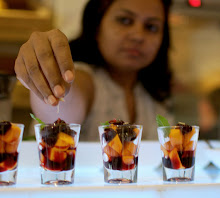
This season I was lucky to witness holi celebration at the Oxford Book Store at Connaught place where a team from The Park was doing a live demonstration of a few holi recipes. They made pistachio and almond thandai, gujhia, namkeen pare and a really nice gulab ki kheer.


It was wonderful to witness colours of holi in a bookshop. I loved the gulab ki kheer the most. Thandai was really good too with rich green colour of pistachios.

Bringing more holi recipes really soon. I am focusing on the malpua as that is one of my childhood favourites and I make it just once a year. Wishing you all the happy colours of spring, more happiness more peace. Stay away from chemical colours and chemically flavoured foods.

Stay tuned for more recipes here..

Tuesday, March 26, 2013

thandai : the quintessential holi drink | recipe of easy homemade thandai ...


Homemade thandai and easy? Yes. It takes just under 5 minutes to soak the ingredients and then another 10 minutes to make a paste after the soaking time. A concentrate of thandai is ready to be refrigerated and used as required. Add milk and enjoy thandai any time you like.

You must have come across Haldiram's Thandai or Mishrambu that is manufactured in Banaras. These bottles of thandai concentrate fly off the shelves of supermarkets and small shops alike during holi season. Thandai is a cooling drink to be enjoyed all over summer, but holi is the time when we start having thandai officially.

I had been planning to post a thandai for very long. Last year I made thandai after holi, took pictures too but that couldn't come to the blog. This time I thought let's treat you with this refreshing aromatic drink for the festival of holi. The bhang plant grows in my garden, it self seeds every year and I use it whenever required. For bhang waali thandai, there is nothing better than freshly plucked bhang (Cannabis leaves). Though nicely dried leaves are very aromatic as well.  Use dried leaves if you want.

Here is what you need for making about 10 glasses of thandai...


ingredients...

2 tsp fennel seeds
1 tbsp khuskhus or poppy seeds
1/2 cup of cashew nuts
1/4 cup of almonds
about 15 whole peppercorns (you can mix black and white peppercorns both)
1 tbsp dried rose petals
a generous pinch of saffron threads
about 2-3 tbsp of chaar magaz (melon seeds) is also added to this mix, I didn't have it this time

1/2 cup of sugar (or to taste)

Since I have some fresh bhang (cannabis leaves) growing in my garden, I used that too to make a bhang waali thandai, used 10 leaves to make 2 glasses of the green bhang waali thandai.

9-10 glasses of chilled full fat milk will be required to dilute the concentrate to make fresh chilled thandai.


procedure...

Soak all ingredients except milk and bhang leaves in about a cup of water or to submerge them all well. A minimum 2 hours of soaking will be good.

Blend in your mixie or food processor to make a smooth paste. Add the sugar too while blending the mixture.

Empty in a jar with lid as this is the concentrate to be refrigerated. If making fresh thandai for immediate use, dilute with chilled milk, blend again if you want it frothy and serve. Otherwise, take 2-3 tbsp of the concentrate, dilute with chilled milk to make a glass of thandai and serve.

To the same concentrate mix of thandai, add bhang leaves as required and blend again. Refrigerate or dilute immediately to make bhaang waali thandai. The regular thandai is also called kesaria thandai due to the use of saffron in it.


 If the kesaria thandai doesn't look enough yellow (kesari), don't worry. The blended saffron threads keep releasing color into the concentrate mix and make it quite yellow the next day..see how it releases color after just 5 minutes of blending..Adjust sweetening as per taste.


Bhang waali thandai has a very aromatic flavor of bhang, something relished by those who love it.

The Kesaria thandai has a prominent flavor of saffron, fennel and a mild hint of peppercorns. Richly nutty of course.

The amazing thing is, these hot peppercorns are cooling in nature when ground with water and taken with cold milk. The other ingredients are all cooling in nature as well.


 Now you realise how easy it is to make thandai at home. It doesn't take much time or effort as well.

Happy holi to you all and please do let me know whenever you try this recipe.

Cheers...

a rose flavored sugar free kaju katli and a regular kaju katli...


Yes two ways with Kaju katli, the famous Cashew nut fudge that is the most loved mithai all over India.  Probably more so because it has a better shelf life than any other good mithai. Stays well for a month or so. And both these versions of kaju katli are microwave cooked.


I made this no sugar added version which has some lactose in the form of the milk powder I added to bind, this one is flavored with rose petals and rose water. Lactose sweetens the kaju katli lightly. Rose petals and rose water make this kaju katli quite fragrant.

 The other one is a regular sugary kaju katli but with less sugar than the commercially available ones, no flavor is used in this one because the flavor of Cashew needs to shine when it's on it's own.


 Lesser sugar means poor binding and darker color. Sugar binds the cashew paste really well and makes it lighter in color after cooking, but this dark looking kaju katli has great cashew taste, sweetening is medium to light I would say. For some people it will be light, to me it is perfect.

Even the milk powder and cashew version, is lightly sweetened, with a hint of milk too. I personally do not like milk or khoya burfi or fudge so this one would not be my favorites, but the husband likes this milky one better. Different choices you see.

ingredients for rose flavored, no added sugar kaju katli...


broken cashew nuts 4/5 cup or 87 gm (see the picture on weighing scale)
milk powder 3/4 cup or 66 gm
rose water 2 tbsp
full fat milk 1/4 cup
dried rose petals 1 tbsp or more

procedure...

Powder the cashew nuts finely, it might start getting lumpy and oily in the end so take care not to make it cashew butter. Just stop when the powder starts getting crumbly.

Add the weighed milk powder and about 1/4th cup milk and a tbsp of rosewater in a microwave safe glass bowl, mine was a Borosil one.


Mix everything well. The milk powder slowly dissolves and allows a sticky paste to be formed.

Now microwave for 1.30 minutes, the paste will fluff up in the microwave. Take out and stir and mix well again. See how it looks in stages. The mixture is microwaved for 1.30 minutes each time, taken out and stirred with a spoon. Repeated 3-4 times till the paste forms a ball.


Add the rose petals in last, mix well and let it cool till you can handle it with bare hands. It becomes very oily as the fats separate.

Keep a parchment paper ready folded like a book. Place the ball of cashew paste on one half of the parchment and cover with the other half. Roll out with the help of a rolling pin.


You would want a perfectly square or rectangular sheet of rolled out fudge so make sure you fold the parchment paper inwards from the open edges. See pictures to understand. Roll out the fudge to fill in the corners as well. The thickness should be the same all over.

Lift this rolled out fudge along with the parchment paper casing, place it on a appropriately sized tray and refrigerate till cold.

Measure with a scale if required and cut into squares or diamonds.


There is a hint of milk in this kaju katli, and that's where the rose saves it.
Rose flavored kaju katli with a hint of milk that you might miss if uninitiated.

ingredients for the regular kaju katli...

broken cashew nuts 2 cups or 220 gm
sugar 3/4 cup or 100 gm
you might want to add green cardamom or saffron, but I like it unadulterated cashew flavor

procedure....

This one is a cashew and sugar fudge, the regular kaju kali. Sugar helps in binding the paste and since I have used minimal sugar the texture is not very smooth. But taste wise it is a better version of a commercially made Kaju katli. A very intense taste of cashew just lightly sweetened.

The cashew nuts are soaked in water, just enough to cover them all, for 2 hours minimum.

Then they are blended till they make a smooth paste, add some of soaking water.


Now add the sugar and cook it in a thick base pan or in a wide glass bowl in microwave. If cooking in pan, keep stirring and cook till it becomes a sticky ball. If doing in microwave, take out and stir every 2 minutes for about 5 times and then every 1 minute 2-3 times.


Stirring and mixing each time you take the mixture out. It should make a sticky ball in the end, and when smoothened with the back of a spoon, it should get a smooth surface. See picture.


Let it cool till it can be handled with bare hands, Make a smooth ball place on a parchment paper covered with the other half and roll out into a rectangle.


Now on the rolling out steps will be like the rose flavored kaju katli. Refrigerate to cool and then cut into desired shapes.


A little darker, a little softer kaju katli that you would get in stores, but a lot tastier that that. And the bhang ki thandai in the picture is also coming soon on the blog..


Wishing you all a happy holi with a colorful post.


Do let me know which one you tried. The good thing is, you can cook them both in pan also. Do shoot me a question if you want to cook this in a pan, I'll let you know what to expect. It's easy any which way.

Cheers..

Tuesday, March 10, 2009

holi ki gujhia


Wishing a colorful holi to everyone. The eve of holi today and 'banaras ka khana' definitely owes you all a recipe of gujhia. Making these gujhias always reminds me of my early days when we all used to take leave and prepare these stuffed flaky pastry collectively at home. Today when I am caught up in so many other things and like most of other people feel like dropping the idea of making them at home, I am glad I manage to make at least some. It really takes you back in the memory lane and you get transported into your past, which is always beautiful.

Gujhia recipe

Despite all the hassles, I make sure the traditional recipes are made at home, this is my way of having a feel of the festival, celebrating it. Believe me I was so happy to do it all, and in the end when you get to taste the fruit of your labor, it is out of this world. I would always suggest to try and make the traditional foods during festivals, it makes you feel happy and contented without having to waste time and energy in synthetic colours, firecrackers etc. Even if you don't have people around to spend time with, the traditional foods bring them back in your memories.

These gujhias are exactly the way my mom used to make. A crispy crust and a crumbly mildly sweet stuffing. It is very addictive, you can't stop at one if you have a sweet tooth. These are calorie bombs though.....:D:D

My mom used to make us all sit and do the rolling, filling, sealing work in the day time, all the stuffed gujhias were kept covered by a moist cloth and in the evening. She used to fry all of them slowly over low heat and that was done after each gujhia was stuffed and covered neatly by moist cloth.

It was a full day's work of making them (in huge amounts of course). Now I don't spend so much time on gujhias, I keep frying them at very low flame and at the same time keep rolling and stuffing them on the kitchen platform itself. Earlier all of used used to sit on the floor to do all this because there was a large quantity being made always.

Frying on very low flame results in better taste and texture, and by the time one batch of gujhia is fried, the next batch is ready after all the artistry done over them. I do the sealing and making pattern by hands. Somehow I feel that when we use the mould to make gujhias they loose their charm, hand carved gujhias have a better look and feel.

Anyway here is the recipe. I make the khoya stuffing in the morning and do all the stuffing and frying in the evening.

ingredients

khoya or reduced milk 500 gm ( I use instant khoya made using milk powder)
sugar powdered 250 gm or more to taste
poppy seeds (dry roasted) 1/2 cup
dessicated coconut dry roasted 1/4 cup or more
suji or cream of wheat 1/4 cup (optional, I skip it always but it helps when the khoya is moist)
almonds chopped 1/2 cup
cashew chopped 1/2 cup
raisins chopped 1/2 cup

procedure to make the filling or stuffing

Roast the khoya in a pan till dry and deep pink in color.

Meanwhile roast the suji in microwave for 2 minutes, turning twice in between. Then tip in the suji into the khoya pan along with all the ingredients except sugar and cook, stirring continuously till a nice aroma comes out and the mixture is dry, crumbly and deep pink in color.

Take off the flame and mix well with sugar and rest till completely cool to proceed, this is how the finished filling looks like...

Gujhia recipe


ingredients for the shell

maida or all purpose flour about 800 gm
ghee or clarified butter about 200 gm
water to knead the dough
sunflower or peanut oil or ghee to fry

Gujhia recipe

procedure

Rub in the ghee into the flour till the mixture resembles breadcrumbs. The flour and ghee ratio may vary because I do it by instinct and never measure them.

Now make a stiff dough using water and let the dough rest for 15 minutes before proceeding.

Take a marble sized portion of the dough and roll a thin roundel, place a spoonful of the filling into it, fold it like a book, and seal the edges by pinching and folding the edge, applying pressure (flour n water solution can be used to seal if doing it for the first time. It has to be sealed properly as if it opens while frying it will mess up everything.

Make sure that the filling is properly secured, repeat the process to make more gujhias.

tip : if you prick each guzia with a pin 2-3 times, it will not split during frying.

Now slip them into hot oil,10- 12 at a time, and fry at lowest possible flame, turning them while frying, may be once.

It takes around 20 minutes for a batch of 10 gujhias to cook, time may vary but you can understand when they become pink n crisp.

Gujhia recipe

Let them cool and keep in airtight containers. The gujhias keep well for a fortnight in the spring time north India temperatures.

There are a few more versions of Gujhia stuffing in Banaras, that I will share sometime soon.

Make some Gujhia now and enjoy.