Showing posts with label reviews. Show all posts

Monday, August 14, 2017

some lost recipes revived at The Great Kabab Factory


I feel really glad when I see homely flavours in a five star hotel. I know most of the people go to the star hotels to have lavish meals served with pomp, something that can’t be created in home kitchens and no doubt that even I love to explore all the rich cuisines and cooking techniques both for the flavours as well as for the academic interest. 
But the most comforting meals are always the ones that revive homely comfort for me. Imagine my pleasure when I find a well made muli besan, a thick kadhi with pieces of radish in it, one of my favourite foods that I cook at home regularly. 

This is what happened when we decided to go to The Great Kabab Factory at Radisson Blu Plaza (Mahipalpur) this Sunday. They have a festival going on, showcasing some of the lost recipes introduced into their regular menu, Chef Vakil Ahmad has brought some intriguing recipes to the table this time.
The Great Kabab Factory

Although the new dishes being showcased are not lost from the cuisines, the dishes were definitely something people have started forgetting slowly. Apart from the muli besan I mentioned, the keema stuffed karela, the kheibari murgh ke parchey and murgh kabab gorkhar made us bow to the skill and hard work of Chef Vakil’s team. 

The menu was impressive with numerous starters, the signature galouti kabab, pathiya sekiya kukkad (chicken grilled over cow dung cakes, a Patiala specialty, recreated in tandoor), silbatte ke kabab (kababs made of stone ground meat), mahi kasoondi tikka (fish tikka in mustard marinade), murgh kabab gorkhar (stuffed and roasted whole chicken), kheibari murgh ke parchey (schnitzel style chicken kabab) and some impressive vegetarian kababs like subz galouti kabab and taza phalon ki chaat. 

The main course had the signature dal panchmel and dal makhni, the delicious muli besan being the new entrant. The sakora gosht (meat curry slow cooked in earthenware) and Kallu miyan ki raan from Lucknow were done to perfection, the biryani made of seviyan was one of the attraction as this type of biryani is made rarely now. Seviyan biryani takes some skill and expertise to be done right and Chef Vakil’s team had done a wonderful job. 

The desserts included the dahi halwa from the kitchen of Sailana, gulab ki kheer and UP style malai chaap apart from TGKF signature kulfi and jalebi. 

My most favourite pick from this menu is the keema stuffed karela and besan muli as I mentioned above, the galaouti kabab has always been great at TGKF and the rotis have always made us feel indulgent. In the menu you would get the exotic foods as well as the homely comforting foods, the best of both worlds.
TGKF is a place where we take our guests who want to eat good kababs and biryani in one place, served in traditional Indian style, where the menu is fixed and the wait staff bring everything to the table insisting you to take more servings, just like it was done in wedding parties few decades ago. 

The Great Kabab Factory gives a glimpse of the traditional Indian hospitality in this aspect.


Sunday, August 13, 2017

Colonial Anglo-Indian food to celebrate Independence day at J W Marriott Aerocity


We are always awestruck by the variety we have in our country in terms of food and produce, whenever we chance upon something new in a far corner of the country or even sometimes in our own backyard. The foreign cultures have influenced the cuisines of India and have added more layers of flavours on them, each one worth exploring whenever you get a chance.

So when I got to know that Bridget White Kumar is in town to curate a colonial Anglo-Indian menu at K3, the all day dining restaurant of J W Marriott Aerocity I decided to go and meet her as I have been following her work for quite some time. Bridget has authored 7 books on the subject of Anglo-Indian cuisine and has been helping many hotels and clubs to create special menus around the cuisine. 
 
She has been sharing recipes on her blog as well, a really warm and affectionate person I must add.
 
Bridget White Kumar and Chef Vivek Bhatt

Chef Vivek Bhatt has collaborated with Bridget to bring Anglo Indian food to the capital for the first time, to celebrate Independence day week, and his team has done a wonderful job of recreating the fusion of flavours beautifully. I was there for lunch yesterday sharing the table with Bridget, Rohit Sharma, Nikhil Nair and Chef Bhatt and we ended up discussing the present day politics and how we have performed (not) as a country in the last seven decades of being free of foreign rule. We decided anonymously that Dak Bungalow Chicken comes to comfort in such a scenario as none of us are keen to join politics to bring any of the changes we want in the leadership. 
 
Food is a great tranquilizer, or equalizer too. Let's go to the table.

The Anglo-Indian food is served in a beautifully laid out buffet, the menu changes everyday for lunch and dinner but a few signature dishes are constant. I loved that the menu has not been made too extensive with dozens of dishes, one can taste and savour every single dish and come back with the flavours still teasing the memory of the palate.

The starters appeared to have jumped out of a high tea party of a memsahib, all wonderfully made. The Mushroom scramble on toast, the Lamb mince chop (Bengali style) and the Panthras were delectable, though not my kind of food, the husband would have taken several helpings of these I know. I had my eyes firmly focused on the main course that looked like homely comfort so I took care not to fill myself up with the starters. 

Anglo Indian food at K3, J W Marriott Aerocity
 
The Kedgree needs a special mention as this was the first time I was tasting an authentic kedgree, though I have mentioned it on this blog earlier. This was made of mung dal and rice, cooked perfectly so each grain was separate yet cooked well, the taste and the texture reminded me of a similar dish I have had at an Oriya friend’s place but I have forgotten the name of the dish as it has been almost 15 years to that dinner. I wonder if there is a connection between the two. The usual garnish of boiled eggs was missing as the kedgree was to be made suitable for vegetarians too, you won’t miss any garnish because there are much more flavourful food to devour. 
 
Check my main course plate here on Instagram

I have had many versions of the Dak Bungalow Chicken but the one served at this festival was so light and flavourful with a thin yogurt based gravy that it will be the benchmark from now. The Lamb Country Captain, the Pork Devil Fry and the Prawn Temperado were a delight to discover. 

Each one had its own identity in terms of flavours and appearance, the Lamb Country Captain felt like a light homely curry we make at home, the Pork Devil fry had green capsicum and garlic flavours, the Prawn Temperado with a pleasant caramelised onions and tomato flavour and a hint of tartness to balance.
 
A special mention to the Okra in Butter and Garlic, the vegetarian main course that I loved so much that I tried to recreate the dish today. I knew it was something the husband would love and I was right, this recipe is going to be repeated frequently all through the bhindi season. More about this in the next post. 

The desserts were the classic Trifle and a Roli Poli pudding which is a steamed jam cake so light you can easily over eat. Better take a small proration and eat small bits of it, take your time to finish if you are sensible or save some space for desserts. 

More than the food, it was a delight to meet Bridget in person. I have been connected with her on social media for a long time but was meeting her for the first time in person. She has done a lot of work in discovering and preserving the family recipes and she has been doing it ever since she took voluntary retirement from her banking career. She found her mother’s and grandmother’s recipes hand written and filed along with knitting and embroidery patterns and revived all of those classics meticulously converting the weights and measures as most of the recipes written by the women had measures written in the form of a housewife’s manual, 2 anna’s coriander leaves and 3 anna’s onion must have been difficult to convert to grams and tablespoons. Anna was a unit of currency during British period.

I admire Bridget to have done such wonderful work of documenting the recipes and bringing the flavours to us, each fusion and progression in the history of cuisine is an important link with the older history as well as the changing times I believe. Food reflects the society at so many levels, each recipe brings a new story sometimes. 
 
Bridget is here for just one week so go soon and discover these stories and flavours. You would love to meet the humble and cheerful lady behind this food too. 


Sunday, April 9, 2017

Kumaoni food at Abbotsford Nainital


Nainital is not just a hill station known for the beautiful Naini lake. This quaint little town is known for the wild life, the wild life conservators, educational institutions, clubs and the lush green pine forests with a blue hue that reflects magically in the Naini lake too.

Naini lake

Incidentally this is my birthplace too and there are many childhood memories attached to the lake, the sepia toned pictures in our family album have kept the memories alive. We have made a few quick trips to Nainital in between but I have been meaning to go and stay there for a relaxed holiday to get more insights into the culture and cuisine.

I got a chance to get a glimpse of the cuisine in the meanwhile, when EatwithIndia organised a culinary tour of Nainital is association with Abbotsford, the heritage home of Janhavi Prasada who graciously hosts guests in the ancestral property that has been converted into a home stay.

Kumaoni food at Abbotsford Nainital

Along with Sonal Saxena of EatwithIndia we reached Abbotsford a little ahead of lunch time few weekends ago and what we experienced was nothing short of an ideal hillside holiday sprinkled with great food.While Delhi had already started getting hot around that time it was great to feel the nip in the air even during noon time.

After a customary welcome teeka, flowers and Rhododendron drink we headed straight to the lunch table set up at the Cafe Chica lawns.

The first thing served to start the lunch was sana hua nimbu and it was the best I had tasted till date. I took the recipe and created at home after I returned in fact. 

I was not particularly hungry but the Kumaoni home style food was so delicious I overate after ages, so much that I skipped dinner that day. The sticky hand pounded rice had come from Janhavi's aunt's farm and the kapha (Kumaoni spinach stew) felt like the best pairing with that flavourful rice. The other dishes like gahat (horse gram) ki dal, alu gutka, ganderi ki subzi, kheere ka raita, bhang ki chutney and bhatt ki chutney were all so flavourful we all took multiple helpings, mopping everything up with mandue ki roti.

We went for a long walk towards the Naini lake after lunch, enjoyed boating, walked around the markets and the mall road after lunch.

Naini lake

Janhavi cooked a country style chicken curry on wood fire for dinner and one of the guests Kunal Mandal conducted a quiz that I participated despite splitting headache. We talked about how and why we need to conserve regional traditional cuisines so the ingredients and cooking techniques are not lost forever. I couldn't stay on for dinner but heard it was as good as the lunch.

Next day Janhavi took everyone for a farmer's market walk and then to the boat club. Once back the lunch was laid down again in it's finery.

Kumaoni food at Abbotsford Nainital

These were all Janhavi's family recipes, cooked expertly by their family cook who takes care of the home stay kitchen too. It's very rare that cooks can recreate family recipes so expertly but Abbotsford has kept the mark high, the food is to die for.

Kumaoni food at Abbotsford Nainital

The mooli ki kadhi, home style mutton curry, methi chaman, khatta meetha kaddu, bhune tamatar ki chutney etc were all great, bursting with flavour and made so well. Thanks to EatwithIndia we got to taste all such homely food from the region, that too from the repertoire of a family. We tasted delicious Singhal, a spiral deep fried sweet pastry made by the cook and it was delicious.

The Cafe Chica at Abbotsford is quite popular among locals and travelers, although it is located at a steep climb but the view is worth it.

Abbotsford Nainital

The alfresco seating is the best as you get to see lot of birds and the cheena peak in the background.

 I stayed in the Juliet room. Here is how the room looks.

Abbotsford Nainital

The full length window opens to this breathtaking view.

Abbotsford Nainital

My stay was short but I resolved to go back really soon to soak in the mountains, Abbotsford will be a natural choice now. All the rooms are different as it has been a private home, it actually adds to the warmth the homely hospitality extended by the people behind Abbotsford.

Abbotsford Nainital

This short weekend trip packed so much and yet left us hungry for more.

Thank you EatwithIndia and Abbotsford for this cherishable experience. The taste of the best Kumaoni food I have had till date, will be etched in my mind forever.


Friday, February 24, 2017

when Tunday's kababs come to town


People have started wasting so much food these days, lamented Mohd. Usman, fondly known as Usman Bhai in Lucknow, when I asked him about the new experimental Mughlai foods. People want more variety so we have to cater to it but no one values food like the good old times when only 3 dishes (known as teen khana) were served for wedding feasts and that was Korma, Sheermal and Biryani. The well to do hosts served 5 dishes which was called as panch khana (five course meal), including the kababs and paratha too, which was considered as the highest limit for the commoners. Now there are hundreds of dishes served in a wedding party and there is so much wastage of food that is criminal, he rued.

Usman Bhai's words ring a bell. We are living in the age of illusionary abundance and we want more. The five dishes he talks about are seeped with the culinary tradition and the flavours embrace you in their comfort like a grandmother, a 13 course meal somehow fails in bringing that comfort zone.

Chef Moh. Usman is the grandson of the legendary Tunday Kababi and is currently in Delhi sharing his food legacy. Tunday's Galawat ke kabab are such a genius that we have been revisiting every time we are in Lucknow but when it comes to Delhi we can't afford to miss it. The spice blends are guarded and the myth is that they use 120 spices in it. Go figure.  

It is at JW Marriott New Delhi Aerocity where he is currently hosting the Tunday Kababi Festival at K3, the multi cuisine restaurant. We joined him for dinner last Friday and had our fill of Galawat ke kababs, Ulte tawe ke paranthe, Biryani, Paya Shorba and Nihari.


When I saw Usman Bhai scooping out the mutton mince mix for galwat ke kabab and casually patting it over the mahi tawa using his bare fingers, just like he does at his own place, I knew we are getting transported to Lucknow for a while. The Kababs tasted better than their own place I must add, it might be a case of better ambiance but the silken texture of the kabab held more flavours that day.

The Biryani was exactly the same flavour wise, the same aromatic subtle spicing, each grain of rice replete with the flavour of meat and the meat tender enough to become one with rice in a mouthful. Although the quality of rice was different at the hotel but it didn't make much difference to the flavours that we enjoy at the Tunday's Lucknow.

The Paya Shorba was rustic and unpretentious as it should be, the healthy concoction that it is. The Nihari too revived the taste of Lucknow, the ulte tawe ka paratha was made smaller but the right technique of making it was evident.

The specialties from Tunday's are available as a buffet spread for just a few more days, till Feb 26th so you can go and taste the authentic flavours of the famed Tunday clan. It is worth the commute to the Aerocity I must add, as its not everyday that you get to interact with a legend who wants to stick to those panch khana and keep whipping these all his life.


Tuesday, March 1, 2016

my experiences at Suryagarh Jaisalmer, the royal luxury hotel in the midst of golden sands


Suryagarh Jaisalmer

The thought of Rajasthan brings a splash of colours in my mind, soulful music by Manganiars and Kalbelia dancers apart from the fiery food. All these powerful images in the background of almost monochrome deserts that can make one terribly sick in a summer noon. Rajasthan is the land of nature’s extremities and sheer human will to conquer that.


Suryagarh Jaisalmer

Jaisalmer is the western tip of this desert state and has a glorious past being a part of the silk route that connected this desert to other parts of the world, this desert welcomed many travelers from all over in return. We visited Jaisalmer last month and were smitten by the exotic charm. The landscape looks like another planet but the colourful splashes of the tribal dresses and artisans, glorious buildings and bazaars inside the city leaves one mesmerized.

We had the privilege to stay at Suryagarh Jaisalmer, nominated among top 10 luxury hotels of India and it turned out to be one of our best travel experiences. Suryagarh pampers the guests so much that I had started hearing stories about it even before we landed there. 

Suryagarh Jaisalmer

We took a flight to Jodhpur and the hotel had sent a car to receive us. Seeing the driver with my name on placard at the arrival lounge gave me an idea what the hospitality is going to be like. The car had all the wet towels, chilled drinks and jars full of sweets and savories for the 5 hour drive that would take us to Suryagarh.  

camels


The drive through the desert was quite interesting as we saw hoards of camels and even got to drink freshly milked camel milk thanks to our affable driver Bhanvar Singh. Green Bee Eaters on the roadside wires and Chinkaras on both sides of the roads kept appearing every now and then while the car kept speeding up on the smooth roads. We stopped at a roadside dhaba for lunch and got to taste wonderful local meal of papad methi ki subzi, gatte ki subzi, sev tamatar ki subzi with bajre ki roti and buttermilk. 

A guard of honour was given to us as soon as we entered the city and a jeep with guards and Suryagarh flags started driving ahead of us. 

Suryagarh Jaisalmer

This brought a huge smile on our faces, the smile got brighter as we entered the gates and a pair of camels welcomed us and started walking ahead, leading us to the outer courtyard to drumbeats and Rajasthani welcome songs. 

Suryagarh Jaisalmer

Atithi Devo Bhava taken to the next level. Nakul Hada greeted us with his team, tilak was applied by Pandit ji and a shower of rose petals next, we were led to our rooms that felt like a warm cocoon after a long drive. 

Suryagarh Jaisalmer

An invitation for the evening musical programme was waiting for us on the table. 
Our room, The Signature Suite was going to be our home for 4 days, it was one cozy comfortable room with fruit laden platters and fresh Mithai being replenished every day. 

Suryagarh Jaisalmer
Suryagarh Jaisalmer

After freshening up and tea and snacks in the room, we went for a tour around the property before going to the plush backyard where they host the musical performance by the local Manganiyars every day.  

Suryagarh Jaisalmer

Manganiars are traditional Muslim singers from this region and Suryagarh has employed a whole family with them, so member of the same family keep singing in different locations for different events and all of them are great singers. We spent a very good evening listening to their songs of longing and love, some dance and storytelling. 

Suryagarh Jaisalmer

Suryagarh team has laid out charpoys, chairs and comfortable cushions for the guests under decorative canopies where one can enjoy the music. Diyas and lanterns are lit up beautifully to make the atmosphere surreal.

Later we went for the romantic dinner on the sand dunes where the group of Manganiyars were performing by the campfire. Suryagarh team arranges a luxurious dreamy dinner on the dunes with mattresses laid out on the sand, pillows and quilts for the cold winter evenings and numerous lamps dotted along the sand dunes.

Suryagarh Jaisalmer

A team of chefs keeps bringing game meats and several other types of traditional shikar style food in earthen plates, drinks keep flowing and music gets better and better as the moon rises in the sky. We even spotted a shooting star thanks to Nakul Hada who caught a glimpse first and alerted us.

Suryagarh Jaisalmer

The menu they have curated for the ‘dinner on sand dunes’ is very interesting as they serve only shikar style meats and some wild berries and legumes from the region, cooked the way locals do it. We tasted some game meats, some Kumutiya (a local legume) beans and some ker sangri cooked the way locals eat. Delicious food, wonderful service, very well balanced flavors but the ambiance is such that it takes away your breath. All you remember is the star lit sky and the sufi songs in rich soulful voices.

Suryagarh Jaisalmer

Next morning we took a tour of the garden in the front, watched a wonderful sunrise, went for a walk and took a round of the kitchen garden they have on one side. It is always a pleasure to see the fresh vegetables being grown for consumption and they even grow all the flowers they use for decorations and bouquets. I talked to the gardeners, asked them how do they grow all this in such a harsh desert climate. The gardeners are very friendly and introduced us to everything that was growing. 

Suryagarh Jaisalmer

Later we enjoyed methi paratha made from methi leaves plucked after we ordered. Such luxury of farm to table meals, even though only the fresh produce comes from the garden it is so much better than importing exotic stuff. Although they have fewer options in the desert and they do get all the fruits and some vegetables brought from big cities. 

The breakfast service in the central courtyard is spectacular, their Halwai breakfast is quite popular I heard. Could not try myself as I wanted light breakfast everyday.

Suryagarh Jaisalmer

Nosh, the all day dining restaurant offers breakfast buffet that is quite good and one gets great variety of traditional and contemporary options. 

Suryagarh Jaisalmer

We always found ourselves on these tables in the veranda outside Nosh. Their fresh mint tea had become a favorite during my stay.

Suryagarh Jaisalmer

The second day Thar Desert trail was planned and that was an experience that I will remember for a very long time.

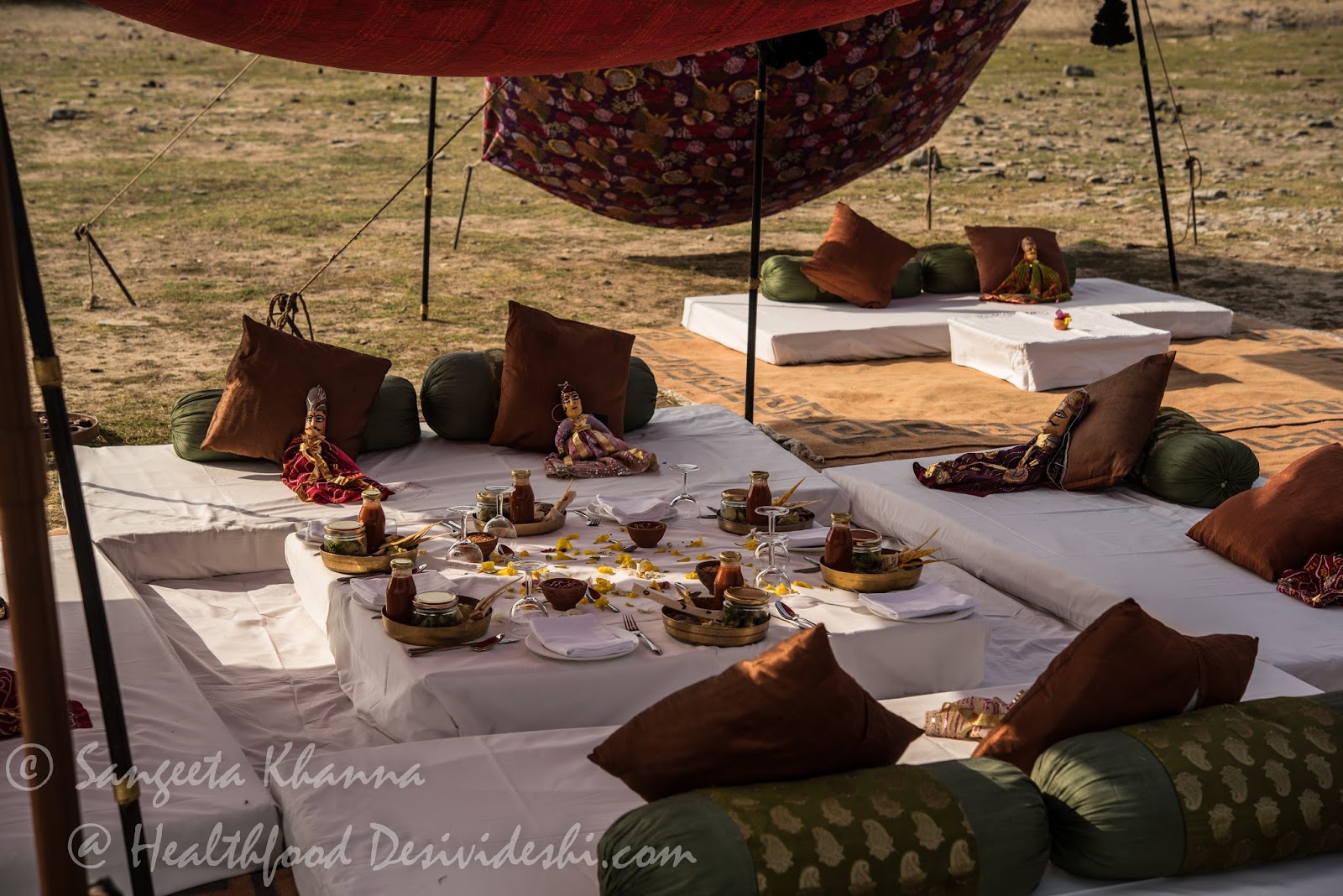
The Thar trail also treats you with a unique luxury of a meal (lunch) by the lake with beautifully laid out mattresses under colourful canopies, picnic style food and much more. I will write about my experience of the Thar Desert trail separately in detail, I want to do justice to this very well curated trail that piqued my interest in History.

Suryagarh Jaisalmer

Thar trail was quite exhausting too and I had a Thermal salttherapy waiting for myself at Rait the Spa. The Thermal Salt Treatment was very soothing for my system, Arvind took the Spice Scrub Treatment advised to him by Mr. Mahesh, the Spa Manager and he also came out beaming after the spa. We went for another small walk and it was time for dinner.

Suryagarh Jaisalmer

That day ended with a light meal at the Legends of Marwar, the royal themed restaurant where the food comes under a canopy. The thali at The Legends of Marwar is quite heavy with all the traditional fare, we opted for a vegetarian thali and it proved to be one of our best regional meals ever. 

Suryagarh Jaisalmer

I strongly recommend the thali meal at The Legends of Marwar. The best thing is that they serve ‘royal heritage fennel liquor’ at the end of this meal which is supposed to be a digestif. It was very good, comparable to Absinthe both in taste as well as potency. 

Next day we planned a tour of the city, the fort and the market. The city has so much to offer one needs a few days to discover things. Jaisalmer is known for the yellow sandstone utensils, sculptures and building material. The old Havelis and even the Jaisalmer Fort is made of yellow sandstone, the front gates and jharokhas are always carved intricately. 

Suryagarh Jaisalmer has recreated the elements in it's arches and jharokhas and even the outer facade.

Suryagarh Jaisalmer

The landscaping around the main building can be seen only when you venture out for morning walks. I recommend that strongly.

The hotel is built like a fortress that stands tall in the desert landscape. This was the view from my room. Beyond the boundary walls of Suryagarh the desert spreads till the horizon.

Suryagarh Jaisalmer

Apart from the Khejri (Prosopis cineraria) and Rohida (Tecomella undulata) trees there are many shrub species that grow in this desert. Windmills are numerous and have become a part of the landscape.

Suryagarh Jaisalmer

The typical splash of colours is seen when Suryagarh is decorated for the weddings. Yes it is a popular venue for destination weddings. Imagine getting married in midst of the mystic desert, surrounded with royal luxury and tremendous pampering.

 Suryagarh Jaisalmer

Suryagarh Jaisalmer team pampers you a lot. We suffered withdrawal symptoms when we came back home. And it doesn't happen easily with us.

More stories from Suryagarh and Jaisalmer soon. Stay tuned.


Thursday, February 25, 2016

Flavours of Kashmir at Latest Recipe, Le Meridien, Gurgaon


We get very few opportunities to learn from maestros. Learning about a cuisine considered as awe inspiring as Kashmiri is an opportunity I can't miss. 

Kashmiri cuisine has been awe inspiring for me always. I love the Khatte Baingan, Haakh, Gogji Nadur, Chaman Kaliya and the likes, have been cooking these home style Kashmiri recipes for long but had never experienced a Wazawan.

Wazawan is the Kashmiri wedding feast that is supposed to be the ultimate gluttony of the highest order. The Kashmiri Waza is the professional chef who cooks for such Wazawan and he is considered an artist in his own right. The fine art of choosing the meat cuts, giving it the right treatment before cooking and shaping the perfect Moche, Rista and Goshtaba, slow cooking the Tabak maaz perfectly after poaching them in stock is the art that brings accolades to a professional Waza in Kashmir or even outside Kashmir. 

So when the much acclaimed food critique Marryam Reshii hosted us for a Kashmiri dinner at Le Meridien Gurgaon, it was a blissful experience to taste and learn from her and Waza Rashid who had been flown in from Srinagar to prepare the feast. It is worth mentioning that Marryam is married to a Kashmiri Muslim and Kashmir is her second home for the last 25 years, possibly more than that as she had been working on Kashmir issues much before that. 

This hand crafted authentic Kashmiri dinner at Latest Recipe, the all day dining restaurant at Le Meridien Gurgaon, was indeed a great learning experience when Waza Rashid cooked food and Marryam Reshii gave her inputs in every possible way. Both of them answered our queries patiently and I found myself getting educated about the finer nuances. Imagine someone who couldn’t differentiate between a Rista and Goshtaba till recently, learning about Butt Haaq and Waza Haaq at the Kashmiri cuisine showcase. Butt Haaq by the way is the Kashmiri haaq greens cooked the Hindu way and Waza Haaq is the same greens cooked the Muslim way, often with mutton liver.

The dinner started with a few exquisite chutneys. Pumpkin, Zereshk, Walnut and Radish chutneys were delicious and one could keep on licking them by spoonfuls if the starters did not arrive. The starters were served in quick succession and we found our plates loaded with Tabak Maaz, Seekh Kabab, Nadru ki Tikki, Haaq ki tikki and Waza Chicken. I liked Haaq ki Tikki more than Nadru Tikki, Waza Chicken was good too but the show stopper for me was the Tabak Maaz.

The slow cooked Tabak maaz was crisp like a cracker on the outside and glutinous soft inside, subtly flavored and perfectly meaty. Waza Rashid informed later when I asked that the Tabak Maaz is made with larger chunks of side ribs when made for traditional Tarami platters and stays moister inside.


Tarami is a huge copper platter that serves four people together during Wazawan. To make the experience more realistic we were served the Tarami platter, a ceramic platter in this case, to be shared between the two of us and how we loved it. 

The Tarami platter came with plain rice and a pulao served on two sides. The rice was topped with Rista, Gushtaba, Aab Gosht, Alubukhara Korma, Murgh Dhaniya Korma, Kishmish Korma and the Moche kabab. I shall talk about my favorites from this Tarami platter and there were too many of them.

The subtle and light Aab Gosht, that is a meat dish cooked with milk was a fine example of how a dish need not be rich to taste great. The Goshtaba which is a very smooth meatball cooked in a milky gravy was perfectly done and oh so juicy and flavourful. Aromatic Kashmiri spice mixes exude a very subtle but potent aroma of fennel, green cardamom, Cloves, Caraway and saffron in such curries. 

The Alu Bukhara korma was pleasantly tart and delicious. Kishmish Korma made me crave for it but I had to stop myself from taking second helpings else I wouldn’t have been able to taste the other delicious offerings on this menu. Moche Kabab was a fist shaped kabab sprinkled with almond flakes, very flavourful, moist and slightly spongy. 

The way the meat is pounded for these kababs and meatballs, the way the fat is added while pounding and the portions of the animal used makes a difference in taste and texture in these fine specimens of different cooking techniques. This is where a Waza proves his skills. 

The dessert was a Phirni with nuts and saffron, with generous lashings of coconut to my surprise. Nicely made and delicious but Kashmir is not known for the desserts as much I know. The Qahva arrived to sum up the wonderful meal and wrapped us with its warmth and the aroma of saffron. 

Waza Rashid kept telling us how he has introduced some vegetarian kababs and some innovative vegetarian dishes to suit the taste buds of people outside Kashmir but there used to be a fixed menu for the traditional Wazawan earlier. He told us about the different types of Dum Alu that is made during Wazawan and how interesting pickles are made with almost everything in Kashmir. 

I reserved my stupid questions about the Ver masala, sun dried vegetables and how they are cooked for Marryam as she is a patient listener and a sweet soul who never gets tired of talking about food, that too her favorite cuisine that is cooked everyday at her home. I told you I came back with some value addition to my food knowledge.

This special hand crafted authentic Kashmiri cuisine prepared by Waza Rashid is available at latest Recipe, the all day dining restaurant at Le Meridien Gurgaon till February 29th. Please go if you want great tasting food and some enlightenment on Kashmiri cuisine.

Please forgive me for the lack of pictures, the ones shared here are the cellphone pictures I clicked that day. There are a few technical issues with my desktop and I can’t edit and upload pictures for a while. I will rectify it as soon as possible and will update this post with all the pictures I have clicked with my camera. Stay tuned. 


Saturday, December 12, 2015

witnessing some old English classics at 1911 restaurant at The Imperial as a celebration of 104th year of Delhi Durbar : 'Durbar ki Daawat'


New Delhi became the capital of British Raj in 1911 when the King George V and Queen Mary coronated the new capital after being shifted from Calcutta to Delhi, henceforth called New Delhi. The Coronation Park still exists as a memorial of the coronation ceremony, one of the many historical monuments of Delhi that we keep visiting to know about this city that has lived many lives, has seen many kings come and go.

Rashtrapati Bhawan (formerly known as Viceroy's House), Rajpath leading to India Gate, Janpath and Connaught place and Parliament House etc are the buildings that were built by Edwin Lutyens after New Delhi became the capital. That part of Delhi is still called as Lutyen's Delhi and is surrounded by a thick swathe of green including acres of Presidential estate, Nehru Park, Lodhi Gardens, the National Zoological park, Humayun's Tomb etc.


The Imperial is one of the oldest and grandest hotels in Delhi located at Janpath road. It is almost like a gem hidden into the chaos of Japath market. But once you step into the lobby and walk past the corridor, you see precious memorabilia from the past and get lost in the serenity.

Chef Prem Kumar Pogakula (Executive Sous Chef,The Imperial) along with his team has curated the 'Delhi Durbar ki Daawat' to revive the flavours of coronation ceremony of Delhi Durbar. Hotel's GM and senior executive VP Vijay Wanchoo has also contributed in this curated experience of Delhi Durbar ki Daawat. At the media preview he kept talking about old recipes, ingredients the old banquets, the art the hotel owns and how the hotel has preserved it's original structure.

The dawat was set up in a plush white canopy, the table resplendent with the finest wine goblets and champagne flutes, salads and irresistible bread rolls. Welcome drink was brought in as soon as we took our seats.


Reading the curated menu placed on our table, it was evident a lot of work has been done to recreate the banquets of the bygone era.

Scotch eggs and broth came to the table first with chunks of lamb, vegetables and pearl barley, half a scotch egg sitting pretty in the bowl. Delicious flavours and textures enriched by barley that I love in my soups. Vegetarians had a Mulligatawny soup, Mr Vijay Wanchoo who became vegetarian later in life told how this soup has Srilankan origin but became so popular with British.

Shepherd's Pie came reminding of how simplicity is the best virtue. The pie was made in individual portions and was melt in the mouth creamy, the mince below was delicious, succulent and rightly spiced. The potato crust browned beautifully, it was a stunner.

The vegetarians had Vol-au-vents, the French stuffed puff pastry that became the favourite of the British. It was served the old fashioned way, a delicious brown lentil sauce poured over them while serving. I had a small bite and loved it. The brown lentil sauce is worth mentioning as it was just so creamy and delicious I took second helping of the sauce.


Vegetable polonaise, a classic vegetable main course dish of 1900s came next. Made of Asparagus spears, cauliflower floret, breadcrumbs and herbs it was an interesting baked dish that I liked a lot. Baked vegetables retained their crunch yet baked enough to get cooked and get delicious.

Pannequets, vegetable stuffed thin pancakes smeared with tomato and deep fried spinach leaves was delicious as well. It was wonderful to witness old classics being recreated.

Bubble and Squeak was an old recipe where the cooks used up the leftover vegetables to make potato cakes that was served as a starchy main course dish with meats. It looked like alu tikkis and I would like it with some grilled meat for sure.

Creamed spinach charmed everyone I guess. Well made and so very creamy. Interestingly, while I was researching about culinary heritage of Banaras last year I got to know that the family of the King of Vijayanagar, who have a palace in Banaras too, loved creamed spinach a lot and it was a regular on their family table.


I loved the Plum and Cherry roasted free range chicken. The roasted fat plums along with root vegetables and onions was a masterpiece in itself, chicken was incidental although well roasted and succulent. I just loved the use of roasted plum, the flavours mingling so well with root vegetables.

The desserts included Rhubarb Pie, old fashioned Trifle and Crepes Suzette.


The Rhubarb Pie was beautifully done, the Trifle really good and some of us polished it off even though it came in a really large serving. What I loved the most was the Crepe Suzette, a very thin crepe folded and doused with orange sauce and flambeed. It was supposedly the favourite dessert of King Edward VII of the United Kingdom, for the right reasons I believe. Very delicate and very flavourful.

It is interesting to see how British took influences from all the countries they colonized. The French and Scottish influence is quite obvious but how they took elements from India, Burma and Srilanka during the colonial times and even later, is a story that I would like to dig in more.

Thanks to Mr. Vijay Wanchoo, Chef Prem Kumar Pogakula, Ruchi Jain and Aparupa Ray Ganguli for giving us a peek into the culinary history. Most of these dishes are still made in their classic form too, but the small variations and even some fusions have occurred in the past century that gives us an idea how the availability of ingredients due to globalization influences the cuisines.

Durbar Ki Dawat is on till December 17th so hurry up and go have a glimpse of a table 100 years old.


Tuesday, December 1, 2015

Dev Diwali in Banaras and Loi Krathong, the festival of floating lights in Thailand have an ancient connection between them


Dev Diwali was recently celebrated in Banaras and Ganga Mahotsav has just concluded. The holy month of Kartik is the season of festivities and the rituals of connecting with the Almighty in one way or the other. I have memories of Banaras being choked with the influx of religious tourists from far corners of India and curious tourists from all corners of the world during these festivals, I rarely gave any importance to the festivals other than the traffic that got deadlocked during these times.

What was it that attracted flocks of tourists and travelers from far away places to Banaras? I am finding the answers slowly and believing more in the theory of the world being a global village.

We were invited to the Loi Krathong festival being celebrated at Radisson Blu Plaza a few days ago. The celebration was organised jointly by Thailand authority of Tourism and Radisson Blu Plaza and we witnessed a few dance performances and Thai Boxing (Muay Thai), the artists and boxers were flown in from Chiang Mai (Northern Thailand).

Loi Krathong is a festival of lights in Thailand and it is celebrated on the full moon day in November, coinciding with the Poornima of Kartik month, the day when we celebrate Dev Diwali in Banaras, Guru Purab in Punjab and Karthikayi in Tamilnadu. I got to know recently that a harvest festival in Coorg called Puthari is also celebrated on the same day. There has to be a deeper connection to this simultaneous celebration in different regions with their roots in Hinduism. Hinduism being the oldest surviving (pardon me and enlighten if I am wrong about the chronology) religion and having branched into a few more religions, Hindu rituals have a deeper connect with the elements of nature, seasons, harvests and rivers I believe. The rituals are a form of living history.

After the cultural program we saw a palanquin carried Miss Loi Krathong to the pool area where she invited the guests to float the Krathongs (boats) in the pool. I was not carrying my camera so a few cell phone pictures are being shared.


It was quite a ceremonious floating of decorated lotus shaped floral boats in the sparkling pool of the hotel. The lotus shaped Krathongs were made of paper, on a base of Styrofoam that helps the Krathong float in the water. I wish the Krathongs were made of real leaves and flowers, we need to take care of the 'environmental sanctity' of the water bodies too.

A candle and few incense sticks are lit in each Krathong before floating it in the water body after making a wish. In Thailand couples do this ritual together and this festival has taken a romantic hue.

The lighting and floating of the Krathongs reminded me of many such rituals followed by Hindu pilgrims in cities like Banaras, Haridwar, Ayodhya, Nashik and many other places. The fire over water symbolism has a deeper meaning, I have been reading about it. Will definitely share sometime.

I must tell you that Banaras celebrates Dev Diwali in a very interesting way. All the ghats are lined up with very high Bamboo poles, a Bamboo wicker basket is ascended to the top of each of these poles with a burning lamp (Diya) every evening and the sky gets lit at the ghats with thousands of these lamps hanging from Bamboo poles. These are called Akashdeep, meaning skylights, and are meant to please the Gods. Hence the name Dev Diwali or Dev Deepawali. Both Loi Krathong and Dev Diwali are celebrated on exactly the same date every year. People float lamps (ghee ke diye) in leaf boats shaped either round or conical, there are a few marigold, rose or lotus flowers in these floating leaf boats as an offering to Ganga ji (the Mother Ganges), such beautiful rituals have survived thousands of years of civilization. 

After the ceremonial floating of the candles, the dinner was served buffet style by Neung Roi, the best Thai restaurant in the city and we stuffed ourselves with our favourite salads (Som tam, Thai pomelo salad and raw mango salad) and then the fruits and desserts.

Most of the salads were served in individual serving bowls at the salad counter of the beautifully laid out buffet by Neung Roi, but the Som tam (Raw papaya salad) was being made at a live counter with all it's usual trimmings. Chef Suthiwaja herself hand pounded the salad in a huge wooden mortar and pestle.

Picture courtesy Mudita Chauhan Mubayi
At Neung Roi you will be spoilt rotten if you love salads and want several helping of different salads. The Thai fruits of the buffet were too good to resist so we skipped mains very conveniently and enjoyed what we love the most without feeling stuffed.

While trying to find out more about the possible links between all these festivals being celebrated on the same day in different regions of India and Thailand, I realised religious festivals serve many functions, some more central that others to the dominant religious tradition within a given culture. 

Loi Krathong in Thiland (a Buddhist country) has little to do Buddhism as a doctrinal system (source). Although this festival appears to be animistic or Bramhanical in origin, it has become at least partially assimilated into the Theravada Buddhist cultural traditions of countries of southeast Asia. According to The Buddhist World of Southeast Asia by Donald K. Swearer, Loi Krathong is a festival related to harvest cycle, celebrated after the back breaking work done in the fields to plant the paddy crop. A way to relax and enjoy. 

The origin of the Loi Krathong in Thailand (see source) according to the earliest evidence, it was started by the second queen of king Phra Rueang (ca 1300 C.E.) who was the daughter of a Bramhin family attached to the court, in order to please the king. There are a few more theories in other parts of Thailand but interestingly one of the theory says that the Krathongs are offered to Mae Khongkha (mother Ganges), the mother of all waters. 

Isn't it interesting to find the mention of Maa Ganga in the tales of origin of this festival?  

All the festivals in every religion and every region is linked to seasons and harvest cycles, or the mountains or water bodies. One way or the other. The symbolism may or may not be relevant in the modern world but the religious connect to nature is evident. 

Thanks to Thailand authority of Tourism and Radisson Blu Plaza for the hospitality and a grand show. I hope to visit Thailand soon and explore more about the cultural similarities we share.