Showing posts with label saag recipe. Show all posts

Thursday, December 21, 2017

Recipe of chane ka saag or chane ke saag ka chokha


Chane ka saag or chane ka saag ka chokha has a wonderful complex flavour even though the recipe is quite simple. The complexity in the flavour is attributed to the mineral content of the leaves of chickpeas which taste savoury with a rich mineral taste when eaten raw. This saag recipe will leave you spellboud with its simplicity and complex flavours.

chane ka saag

Sadly, chane ka saag (leaves of chickpea plants) is not so common in the cities possibly because it needs some time to sort and clean before being cooked. Most people are busy with work and with nonsensical things too sometimes and consider the time spent on preparing food as a waste of time unfortunately. I have overheard some interesting conversations in the weekly vegetables market in my area when people talk about how they would want to eat the greens but wonder who will clean them.

chane ka saag

And then there are the vegetable vendors who come with a chopping instrument to cut the green right there for their costumers, but only spinach and mustard greens can be chopped like that because they are long stemmed and come in bundles, sometimes even methi greens. I wouldn’t ever think of getting my greens chopped like that, without cleaning them thoroughly in my own kitchen. Such pre-chopped greens loose all their flavour and of course the nutrients when they are rinsed in water before cooking so best to be avoided. Smaller leaves take time to sort and clean and that is the reason chane ka saag is not so popular despite being one of the tastiest green vegetable.

I have realised getting older now, that this kind of time spent on preparing food is quite meditative in nature and ensures healthy delicious food for the family.

Chane ka saag is not grown for the leaves primarily but is a byproduct of growing chickpeas. In the vegetative growth phase, before the flowers set in, the growing tips of chickpea plants are pruned regularly to make the plants bushier so it can bear more flowers and chickpea pods. In the rural areas and smaller towns, many women will be seen selling really fresh chane ka saag that they have plucked the same morning, so fresh that it is eaten in its raw form as well, just like a green snack. The taste of the fresh chane ka saag is savoury with a complex mineral punch on the palate, many people Just munch on the fresh chane ka saag by the handfuls and sometimes pound it with some salt and chilies for a coarse dry chutney.

I have grown chane ka saag Just for the leaves many times in my garden. You need to soak some black chickpeas and burry them under 1 cm of soil in a wide pot, it helps if you crowd them together, and keep it in a sunny spot. The leaves emerge in 3-5 days and grow about 6-8 inches tall in a month or so. Harvest them all and use to make any of the chane ka saag recipes from this blog. The whole plant except the base can be used in this case as it is tender and flavourful.

I have memories of such snacks from the holidays we used to enjoy in my grandmother’s village and how some women used to collect chane ka saag in their Aanchal (free flowing part of the sari, used in multiple ways in rural India) and come home to sell the saag instantly. A few saagwali ladies still come to our Banaras home bearing a large cane basket on their heads every morning to sell freshly plucked chane ka saag or foraged Bathua ka saag during winters and I go berserk whenever I am visiting.

I have already shared a few recipes of chane ka saag (saag is a generic name for all leafy greens as well as cooked leafy greens, used interchangeably) like this chane ka saag in a mustard gravy, chane ke saag ke pakode and chana saag dumpling curry, chane ke saag ka achar etc. The recipe I am sharing today is called just as chane ka saag in my home but some other people, especially from Bihar, call it as chane ke saag ka chokha of chane ke saag ki chutney as this recipe can be consumed like chokha or chutney too. I have used this recipe as a dip and as a spread as well with wonderful results.

chane ka saag

This recipe of chane ka saag is so simple to prepare that you may feel like dismissing it in the first glance. But trust me the complex mineral taste of chane ka saag is enhanced so beautifully by the raw mustard oil and green chillies and garlic used in the recipe. Some people tend to use the green garlic for this recipe but I avoid that because the taste of chane ka saag itself is so rich that it doesn’t need any meddling. But go ahead and use green garlic if you like, minor flavour variations make a big difference sometimes for individual palates.

To clean chane ka saag you need to pluck the tips including tender stem and discard the hard stem, I prefer to shuck off all leaves from the hard stem too as this saag is so difficult to come by in the cities and is quite expensive too. This sorting of the saag takes some time and then you need to wash the leaves in several changes of water, I suggest you soak the leaves in a deep vessel for sometime so all the dirt settles down and then wash with several changes of water.You don’t need to chop the saag for this recipe.

Ingredients
250 gm chane ka saag cleaned and sorted
¼ cup water
¼ tsp salt (or more to taste)
10 cloves of garlic
5-6 green chilies or to taste
1 tbsp raw cold pressed mustard oil
Use 2 tsp mustard powder and 1 tbsp extra virgin olive oil if you don’t have access to mustard oil

Procedure
Boil the chane ka saag with water and salt in a covered pot for 4-5 minutes or till it wilts completely. Let it cool.

Blend with garlic and chilies till smooth. Empty in a serving bowl and drizzle the mustard oil on top.
Add the mustard powder while blending if using olive oil as a topping.

Serve with Indian meals of dal and rice or roti along with other subzis. Many people including me mix chane ka saag with plain boiled rice or dal and rice and eat it, I have seen it being eaten like this in my family. I like it with crisp hot parathas as well and of course in many other ways as mentioned above.

Chane ka saag remains one winter delicacy I look forward to every year. Try this if you get chane ka saag in your part of the world or grow some chickpea greens yourself just for this. It is worth all the effort trust me.


Tuesday, February 2, 2016

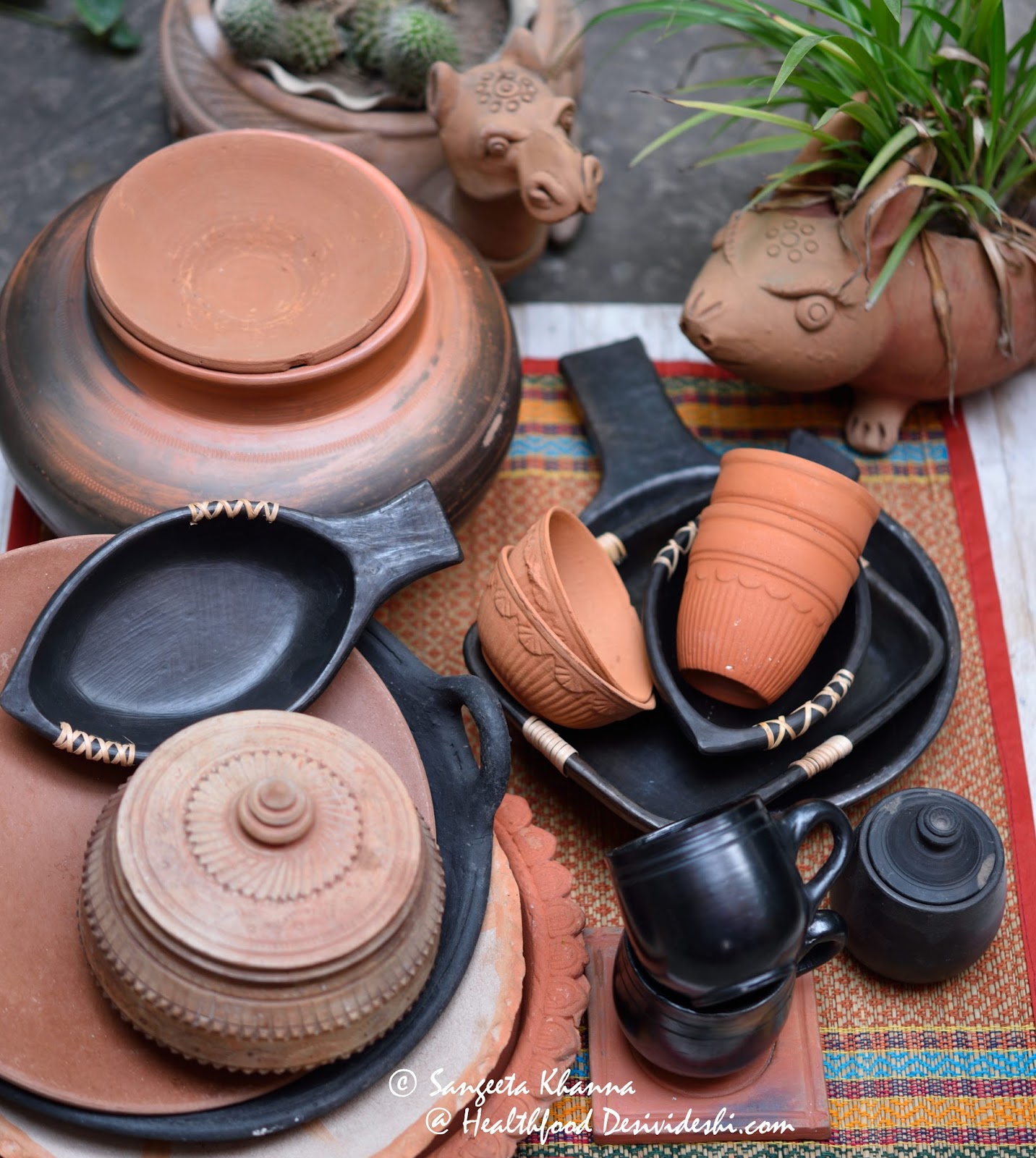
Earthen pots in my kitchen | how to use earthen pots and recipe of handi wala khatta saag from Rajasthan


Earthen pots

The potter’s wheel has always brought a sense of mystic bewilderment. The way those deft hands shape delicate smooth wet earth over the spinning wheel and then how the dried earthen pots are fired at high temperature to become tough to handle whatever comes their way. Some of those pots end up storing water and some overflow with billowing froth of lentils being cooked over wood fired chulhas. Some of the decorative pots are used to set yogurt and some others are filled with syrupy rasgullas to be taken as gifts to friends and relatives. 

making of Earthen pots

I was talking to a potter from Azamgarh who had come to showcase his wares at Constitution Hall in Delhi, and realized that the potters also have ‘seasons’ for the kind of pots they make. During  the wedding season in India they are busy making Kalash and various shapes of Handis and Sakoras (shallow bowls) being used for wedding rituals, the Matkas for holding water, pots for growing plants, Chai Kulhads and Dahi Handis are made all thorough the year at a slow rate as these have a lukewarm but assured market demand.  The urban markets have now started demanding for teacups, kettles, Kadhais and casserole dishes and the potters have started experimenting with new finish, smooth glaze and decorative patterns. I am glad the earthen pots are coming back to our kitchens with a new fervor.

The conversation with this potter from Azamgargh started when I voiced my doubt about the shiny black colour his terra cotta teacups. I asked what glaze or paint he uses for ‘coloring’ the teacups black and whether the color is safe for kitchen utensils. That is when he introduced me with the technique he uses. After the terracotta teacups are fired till they become fully baked and strong, the potters smoke the furnace by adding dried leaves, the smoke and soot coats the pots and gets baked once again, making the pots look sooty black. Mustrad oil is smeared on the pots after firing and smoking,  a second round of firing fixes the black colour and become shiny. Nevertheless, the potter charmed me with his beautifully made black teacups. He assured me that every cup of tea will taste like you are having kulhad wali chai and you can keep washing the cup like any other ceramic or glass cups. 

Later I got to know that Azamgarh black pottery is little known but a technique to preserve and to be encouraged. They make beautiful decorative vases and filigree like patterns on pots.
It feels good to see the potters innovating with the type of utensils they make. The tea sets, decorative platters, bowls and dishes have now become style statements and the potters are catching up the trend slowly as they get demand of such stylish utensils even from some fancy restaurants. 

We are privileged to see the potters still around, spinning life into wet clay. But some of the potters I meet thanks to my passion to collect terra cotta pots, are really poor and are looking for other options to earn their livelihood. I met another potter in Tijara (Alwar, Rajasthan) who embroiders dresses along with making pots to meet ends, he kept requesting me to find a job in Delhi all the while, pottery on its own is insufficient to meet ends for him. Tejaswini Foundation helps these potters from Tijara by taking their utensils to urban markets and getting them some profit but more such efforts are required.

Earthen pots
  
Thankfully there are some potters who are making enough money to keep going. The Longpi pottery from Manipur is beautiful. This black pottery is known to be made with a mix of a black stone powder and clay, the pots are shaped and fired the same way as terra cotta pots and is breakable too. It doesn’t mean these utensils are delicate. One can use them over gas stoves, microwaves and conventional ovens just like Borosilicate and Corning glass utensils, taking same precautions to protect them. Longpi pottery is interesting in the way the potters from Manipur have devised new shapes and sizes from this pottery.

sweet potato hash browns for breakfast
                                              Sweet potato hash browns in Manipu Longpi pan

They make baking trays, beautiful kettles, tea cups and beer mugs, bowls and plates, salad bowls and serving platters apart from their traditional pots and even decorate the edges or handles using cane weaving. Such beautiful and cook, bake and serve type of utensils are becoming more and more popular with urban consumers and finding a place of pride on the dining table. 


Amaranth trial mix

                                      Amaranth trail mix in  a Manipur Longpi bowl

The educated potters of Manipur have already made a place in the trendy kitchenware section and Longpi pottery is available even on some e-commerce websites. I am hopeful for the potters from other parts of the country as well, they have at least not discontinued making earthen pots.

Another interesting place to find exquisite pottery is Gundiyali, a potters’ village in Kutch region of Gujrat. The potters of this village have been making the same designs of pottery since 5000 years apparently as the same designs of pots were excavated from Hadappa and Mohenjodaro too. Interestingly the potters not only use the spinning wheel to make perfectly shaped pots, but they also use a technique called Ghadayi where they gently beat the half made Matka (Ghada or round pot for water storage) from outside using a flat wooden disc with a handle. 

making of Earthen pots

The potters are so adept that they make perfect round Matka using this Ghadayi technique with their hands.

making of Earthen pots

I have witnessed this Ghadayi technique in Uttar Pradesh, Rajasthan and Gujrat to make large Matkas, while the smaller utensils are made on the potters’ wheel completely. 

The potters from some more areas of Kutch have found a way to make pots and pans suited for modern kitchens too and they are marketing their wares almost all over India.  Mitticool website is from Kutch potters and sells various types of kitchen and dining utensils made of Terra cotta. Some unorganized potters from Kutch region make beautiful water bottles with lid, water jugs, insulated casseroles and dinner sets too. Even a Tawa (griddle) with handle and a metal base has started making waves among those who love using Terra cotta pots. Kutch potters are also known for the beautiful intricate painting they do on the pots, much like the Kutchi embroidery.

Baingan bharta and roti

                             Baingan ka bharta and bajre ki roti with kanji pickle

Kerala is also known for the earthenware Chattis (pans) they use for cooking everyday fish and prawn curries. Kerala remains one of those places where common people did not stop cooking in earthenware pots although it became less frequent in the modern kitchens. 

Thanks to our festivals and religious rituals that have helped survive the profession of a potter in the country. Potters all over the country make diyas for Diwali every year and bring them to markets to sell. I remember the Kuldevta pooja in our ancestral home where there was a mandatory practice to cook the Prasad in earthen pots over wood fired chulhas. The village kumhar would be summoned to make specific sizes and shapes of the pots to fill water, milk and ghee and one kadhai in which the Prasad was deep fried in cow ghee. 

I am sure other families and communities had similar pooja rituals and the Kumhar’s art survived due to this constant demand of earthen pots throughout the year apart from the surge in the demand during wedding season of the calendar. Of course there was Durga pooja, Ganesh puja and several other festivals when the Kumhars would make idols of Gods and Goddesses for worship. Interestingly these idols would be immersed in the nearest water bodies after the festival is over. Imagine the fine sedimentary soil is collected from dried up ponds to make such idols which are immersed into another water body after the worship rituals are over. We have a theory of being born of panchtatva and getting merged with panchtatva after death in this country and these earthen idols follow the same path. A potter’s work is enchanting indeed.

chooda matar and chai

                        Banarasi chooda matar served with chai : earthen pots make a difference 
The new age terra cotta pottery could help revive the potters better and bring better profits to them. The terracotta teapots and cups that we use for our everyday chai are a lot better than bone china and ceramic or even glass tumblers. The sedimentary soil that is used for making terra cotta pots is a renewable resource and making of the pots doesn’t burden the environment with toxic chemicals and pollutants and if one is concerned about the cost of terra cotta utensils and their longevity, they are mostly similarly priced as mid level ceramic or glass tableware. Life span of a terra cotta tea cup or a handi can be as good as a glass utensil, the breakage and chipping as easy as any other breakable tableware. Just take care to buy well fired earthenware.


Terra cotta pots are great for dum cooking technique. One can bake everything In terra cotta trays and even curries can be cooked well. Once heated the terra cotta pots need lesser flame heat to keep cooking. In Kerala people line the chatty with banana leaf to slow cook food in minimal oil, in urban kitchens the terra cotta pans can be lined with aluminum foil if required. In earlier days each pot was filled with water for a few days so the pores are filled with some minerals found in drinking water, then the pot is used for cooking. This way the pots do not absorb the aroma of foods being cooked in it. Indian Daal, Kheer, Saag etc cook really well in Handis and people use to look forward to food cooked in them during picnics in earlier days.

To clean the earthen pots after cooking or serving food, just rinse them with water first and then use a hard sponge with diluted liquid detergent or soap nut powder before rinsing them thoroughly with running water. Let them dry completely in sun before storing them away for next use. No need to sun the pots if they are being used every day. In modern kitchens one can heat the cleaned pots in the oven till the water dries up. 

So when you plan to make some rustic Daal or Saag next time try and get a Handi and spend a couple of hours cooking for the family. The Mitti ka Tawa makes the best tasting millet Rotis you have tasted and that too in the comfort of your own modern kitchen.

Rajasthani khatta saag and bajre ki roti

Recipe of Rajasthani khatta saag cooked in earthen Matka
(recipe by Sneh Yadav)
ingredients 

1 kilo mixed greens of Spinach, Mustard, Bathua (Chenopodium) and some Beet leaves etc
60 gm green garlic leaves or chives (or use chopped garlic)
100 gm sour curds
Salt to taste
Finely chopped ginger and green chillies to taste 

procedure 
Wash, clean and drain all the leafy greens and chop them roughly.
Chop the garlic greens finely.
Add all the greens to the cooking Matka along with 500 ml water and cook covered for 10 minutes on high flame. Then lower the heat and simmer for about 40 minutes. 
Whisk the yogurt and add to the cooking saag. Now mash the cooking saag using a wooden mathani (churner). Cook more till the saag becomes mushy but not too smooth.
Add the minced ginger and green chillies. Mix well and cover. Switch the gas stove off and let the pot sit for another 10 minutes before serving.
Serve hot with miller rotis, some raw onions and some fresh white butter over the saag.


 A truncated version of this article was published in Down to Earth magazine.

Wednesday, February 23, 2011

makki di roti te saron da saag | makki ki roti sarson ka saag, the perfect winter food


Makki di rotti te saron da saag, this is how the humble peasant food of Punjab is called. Sarson ka saag makki ki roti is one classic combination that defines how the special food was always defined by the best of the season. Making maaki ki roti and sarson ka saag used to be a ceremony in every home and it still is, most people now make one large batch of sarson ka saag for the whole season and freeze it in batches.

makki ki roti sarson ka saag

Thawing the sarson ka saag, refreshing it with some hot tadka and fresh white butter and some freshly made makki ki roti makes a soulful meal even in modern times. Those who have a big time crunch can get half cooked makki ki roti made in bulk and reheat it over gas flame whenever serving. If there is a will there is a way and we do it for some of the special meals. Makki ki roti and sarson ka saag is one of them.

Making the saag is quite time consuming. It is advisable to wash and clean the leafy greens in advance, boil them with the initial ingredients in large batch and freeze it for future use. Thereafter your job will be easier whenever you want this for lunch or dinner.

sarson ka saag

ingredients 
(served 6-10 depending on side dishes)

500gm of spinach  
250 gm of bathua 
250 gm of fenugreek greens
one kilo of mustard greens 
 half a cup of chana daal
one chopped onion
2 inch piece ginger chopped and a few green chillies

procedure 

Mix everything with 1.5 cup of water and pressure cook with salt to taste. I prefer to pressure cook for 10 minutes after the first whistle. 


Blend this mixture. I prefer a coarse textured saag so I blend it coarsely, you can blend it smooth if you want the other way. After this the saag can be freezed in portions for later use, tempering with the tadka whenever required.

For the tadka, heat mustard oil or ghee in a kadhai and throw in some cumin seeds and coriander seeds (must use this), Then add some coarsely ground onion, ginger,garlic and green chilies, stir fry till cooked but no need to brown them.

Add the everyday curry powder, a generous pinch of garam masala and fry till the spices get aromatic, sprinkling some water in between to prevent the mixture from burning.

Make a coarse paste of fresh tomatoes and add to the frying mixture, add salt and fry till the tomatoes get cooked.


The cooked mixture looks reddish brown. Add red chilly powder if you like it hot. I don't add red chili powder normally. Some times I add boiled peas at this stage.

Now the coarse paste of the saag goes in, mix well and let it simmer for 5 minutes. A little bit of roasted and powdered kassori methi makes the saag very aromatic. Add it and let the saag be covered for a few minutes, off heat, before serving.

Note that the proportion of the spices, onion, garlic, ginger and chillies etc for the tadka depends on individual taste. The tadka can be really light or medium spicy as per taste but take care not to add too much spices and drown the taste of the sarson ka saag. 


sarson ka saag

Topped with white butter and piping hot, this is how the sarson ka saag is served and it becomes soul food for everyone who is blessed by it. Yes it is such a special food of the season.

Makki ki roti on the side, white butter melting teasingly. Many people can't imagine makki ki roti without butter, but I like it both ways, with butter or without it. Once we have white butter in the saag you really don't need much for the makki ki roti but these special meals are indulgent type for many of us. Go with the flow when eating best of the season I say.

If you don't have the luxury of white butter you can have it with regular butter too. But making white butter in a small batch is not too difficult and it takes only about 5 minutes to make a bowl of white butter. See how to make white butter at home. Making ghee at home from the same butter is easy too.

White butter transforms such meals so it is worth investing some time in it.

white butter

As I said and you all know for sure, making the makki ki roti is a matter of practice.

With the right instructions, the task becomes workable though. I have shared an easier way to make makki ki roti with some added oats too.

The instructions with my tips are here to follow if you are making regular makki ki roti.

Take 1/2 cup of makki ka atta for 2 rotis in a bowl, pour hot water over it (about 70 degree C)

Mix well using all fingers, knead with a rubbing motion so that the dough becomes soft. The corn dough has less pliability so it helps to rub it more so that the dough starts binding as you rub.

Add more water if needed, it takes more water than wheat flour, the dough becomes smoother and softer.

Make a smooth ball.

Dust with regular flour.

Use the rolling pin to roll the roti with soft hands, not a very smooth edge but that is fine. My mother used to make perfectly smooth rotis with makki ka atta.

This roti is a bit thicker than wheat chapati, some people can make it very thin too but don't worry if you can't make it thin. It tastes as good if cooked well.

Lift the roti quickly and flip on hot griddle. Cook both sides before cooking it directly on flame.

makki ki roti

Serve hot with butter or without it.

This platter of makki ki roti and sarson ka saag has brought many complements to me, many emotional ones too.

This kind of food brings back memories nostalgia and a pure sense of contentment. Making makki ki roti and sarson ka saag at home is always like a great indulgence for me.